TSPC Newsletter Fall 2026
The St. Paul Center for Theology and Prayer exists to form disciples of Jesus in every congregation. It seeks to do this by equipping and resourcing local congregations for the tasks and joys of faith formation, teaching and learning, catechesis, and the life of prayer.
In continuation of our yearlong theme, Joy in an age of despair, this newsletter we consider ‘Joy in small things’. It’s been a big and busy Summer! As we return to ‘normal service’, with teachers and students back to school, and church calendars refocusing on regular schedules, perhaps it’s a moment to draw breath. Soon enough, the ‘busy-ness’ of the holiday season will be upon us! But for now, let’s pause and find the joy of the everyday.
There are, of course, still many happenings! Almost here is our exciting online presentation from Sarah Augustine - coming up Sept 10th. Details below - don’t miss it!
Don’t forget, you can find our previous newsletters online. If you’re reading this because someone shared it with you, and you’re not yet on our newsletter mailing list, please do sign up here, so you’ll be sure to receive all future news from TSPC!
A THOUGHT FROM TSPC
Peace I leave with you; my peace I give you. - John 14:27
I’ve been at home in the UK over the Summer. Spending time with my parents becomes more and more precious, as we all get older and the years hurry by. Friends and peers of my mother and father are ‘shuffling off their mortal coils’, and funerals seem to be coming up with alarming regularity. At one recent service which I attended with my folks, we had the privilege of hearing short addresses given by the grandchildren of the deceased. Each youngster spoke with their unique voice, in their own way recalling the memories they would treasure of their ‘Pops’. I was struck by how seemingly mundane those memories were. They didn't speak of big holidays, exciting trips, special occasions. Rather, they recalled a shared love of model trains; mowing the lawn together; how their grandfather would fall asleep after meals… Their testimony made clear it was the regular, simple things they had shared that would stay with them.
Back home with my parents, I pondered what I had heard at the funeral. It struck a chord with me. The humble, ‘every day’ routine is what stays with us. Philip Larkin wrote (in ‘An Arundel Tomb’), ‘What will survive of us is love’ (though, in true Larkin style, he could not help but say it was only ‘almost true’...) That love is demonstrated in Larkin’s poem not by an heroic saving of a damsel in distress, but by a gentle holding of hands.
I was just nine when we moved to the house where my parents still live. Shakespeare wrote, ‘The isle is full of noises’; the same could be said for any abode! There are sounds all over a home - scarcely noticed because they are so familiar. One door swishes as it opens over a thick carpet. The stairs creak in a particular way. The click of the bathroom light cord; the certain sound a window makes as it opens: all of these noises are unique - small, simple sounds, but together they create a symphony, the theme tune of a place.
Such tiny, seemingly insignificant sounds have been the background music to entire chapters of my life. There will, I know, come a day when I will not hear that melody again. Those little sounds, old friends I have known for so many years, will cease to be present in my life - like a favourite song no longer played. There will be other places, other ‘musics’; but this chapter will close. The comfort blanket woven by the sounds of my childhood home will no longer be available to me.
Let me treasure them while I can! To quote the Bard again, I will ‘let the sounds of music creep in [my] ears‘. And my heart will be filled with gladness - and with peace.
This is the joy in small things. Life is a tissue of tiny moments which, woven together, create a rich tapestry. When a life ends, it is the shared rhythm, the habitual patterns - the little clicks and creaks, the supposedly insignificant - which we recall and miss.
Christ’s time on earth, as God made man, could hardly have been more immense in its significance. He changed everything. His death shook the foundations of the world. And yet, I can imagine that those who had followed him, had been his friends, missed small things about his time with them. Perhaps Martha thought of the clunk of a bowl which they had used during shared meals; perhaps Andrew recalled the creak of the boat as they crossed the Sea of Galilee together.
The big moments are wonderful and terrible. But perhaps true joy - an unshakeable, deep-seated contentment - comes from the little things. This is where I find the peace Christ offers us. When the state of the world overwhelms - when the way ahead seems impossible - we can focus on the immediate, the local, the tiny, the comprehensible. Huge ideas can inspire and galvanise, but the ‘still small voice of calm’ brings peace.
So I listen to the gentle music of my childhood, and take pleasure in it - and strength from it - while I can. Joy in small things.
Kirsten Cairns
WHAT’S ON AT TSPC - and beyond!
THIS FALL
‘Dismantling the Doctrine of Discovery’ - an online talk with Sarah Augustine, September 10th
We are thrilled to have the opportunity to join with the ecumenical, regional Find a Way sacred journey project, to host distinguished guest Sarah Augustine.
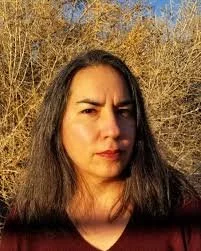
Sarah Augustine
Join us online to hear Augustine, a Pueblo (Tewa) descendent, founder of The Coalition to Dismantle the Doctrine of Discoveryand author of The Land is Not Empty, discuss what is hidden in plain sight: how violence against Indigenous people is ongoing, and how we, as church, are uniquely called to dismantle the systems that continue to justify it.
The talk will be hosted on Zoom, and will include time for Q&A. How can we begin a new chapter? How can we dream of healing centuries of damage? Come join the sacred journey. Please sign up here to attend. (The Zoom link will be emailed to all who sign up.)
The Art of Composing the Prayers, with Gail Ramshaw - hosted by Associated Parishes for Liturgy and Mission September 24th 4pm (ET)
Join Dr Gail Ramshaw, distinguished expert in the language of worship, as she discusses guidelines for crafting expansive and inclusive intercessions and examples of appropriate intercessions for the Christian assembly. Among her many works, Dr Ramshaw is the author of Praying for the Whole World: A Handbook for Intercessors; Blessing and Beseeching: Seventy Prayers Inspired by the Scriptures; and Mystery Manifest: The Triune God, Figuratively Speaking.
To register, send an email with PRAYERS in the subject line to openaplm@gmail.com no later than Monday, September 21. Zoom link and handout will be emailed on September 23.
Ministry Discernment Day - September 26th
How Is God Calling Me? A Day of Resources for Vocations of All Kinds
All who are discerning God's call in their life - in the Church and in the world, lay and ordained - are invited to the Ministry Discernment Day.
The day includes a panel discussion with people serving in a variety of Christian vocations; a presentation by the Commission on Ministry about new features of our ordination process; and an introduction to resources for individual reflection, communal discernment in congregations, and Church-wide discernment programs. After lunch, participants will break into smaller groups to learn more about the programs that most interest them.
People who want to learn about our ordination process in the Diocese of Massachusetts are especially encouraged to attend, along with their sponsoring clergy, potential parish discernment committee members, and family members.
The cost is $25, and pre-registration online is required. Registration opens July 6. For more information, contact Edie Dolnikowski, Canon for Ordained Vocations, at edie@diomass.org.
There is a helpful list of Discernment resources available here.
TRAINING OPPORTUNITIES coming up:
Preaching Among Friends Program - Begins Sept. 20 | On Zoom
The Diocese of Massachusetts is partnering with Preaching Among Friends to offer a lay preaching course. The 11-session program runs Sept. 20-Nov. 5, from 7-8:30 p.m. via Zoom. Tuition is $540 per person, and the Diocese of Massachusetts offers a 50% scholarship to participants. Interested people can learn more and register here.
Lay Eucharistic Visitor Training - October 17 9am - 12pm, St. Mary’s Barnstable
Eucharistic Visitors bring communion to those homebound or in hospital. Eucharistic visitors must complete Safe Church training, be nominated by their priest, attend a diocesan-approved training like this one, and complete an application to be licensed. Parishioners can register here. Other trainings will be offered in the fall and spring.
The Jubilate Chamber Choir presents Hope in the Darkness at two North Shore locations - October 25 and 30
The Jubilate Chamber Choir presents Hope in the Darkness, an offering of choral music and poetry to comfort and inspire us as the twilight of the year approaches - a perfect match with TSPC’s ‘Joy in an age of despair’ theme for the year. The concert features movements from Johannes Brahms’ A German Requiem as well as selections from Felix Mendelssohn, Jonathan Battishill, and Nicholas White, interspersed with poems written by local New England artists that enhance each musical piece - including readings by TSPC’s own the Rev. Jarred Mercer and the Rev. Rita Powell!
Performances:
Sunday, October 25, at 4 p.m. at Methuen Memorial Music Hall, 192 Broadway, Methuen, MA (mmmh.org)
Friday, October 30, at 7 p.m. at St. Paul’s Episcopal Church, 166 High Street, Newburyport, MA (stpaulsnewburyport.org)
Tickets: $20 at the door, $15 when purchased in advance (email Mary Jodice to make purchases). Cash, check, and Venmo accepted.
A portion of the proceeds from both concerts will be donated to The Resettlement Partnership, a local groundswell organization creating affordable housing for refugees on the North Shore of Massachusetts. Learn more at theresettlementpartnership.org.
LAST CALL to sign up to join a REGIONAL LEARNING COMMUNITY for 26/27
We all know that clergy people, be they full or part time, have many demands on the hours in their days. Life can be hectic, with so much to do, and clergy may sometimes feel unsupported, or alone. The St. Paul Center for Theology and Prayer aims to counter that feeling, by giving the hardworking clergy of the Diocese of Massachusetts opportunities to gather; to share ideas or concerns; to support one another.
For those who don’t already know - there are three Learning Communities: one for the Northern and Western Region of the Diocese, one Central Region, and one in the Southern Region. These Communities gather via zoom every six weeks or so, focusing on a particular topic each session. If you haven’t yet joined your local Learning Community, and you’d like to be part of the 26-27 year - or if you’d like to know more - then please email us at tspc@diomass.org
Northern and Western Region Learning Community - hosted by the Rev. Dr. Jarred Mercer
Central Region Learning Community - co-hosted by the Very Rev. Amy McCreath and the Rev. Dr. Richard Burden
Southern Region Learning Community - co-hosted by the Rev. Joseph Mumita and the Rev. Suzanne Wade
SAVE THE DATE: HANNA REICHEL joins TSPC for an online talk, January 30th 2027
We’re very excited that Hanna Reichel, author of ‘For such a time as this: An emergency devotional’ will join us as our guest speaker this Winter. Save the date for the perfect culmination to our year of pondering ‘Joy in an age of despair’. January 30th via Zoom - all details coming soon.
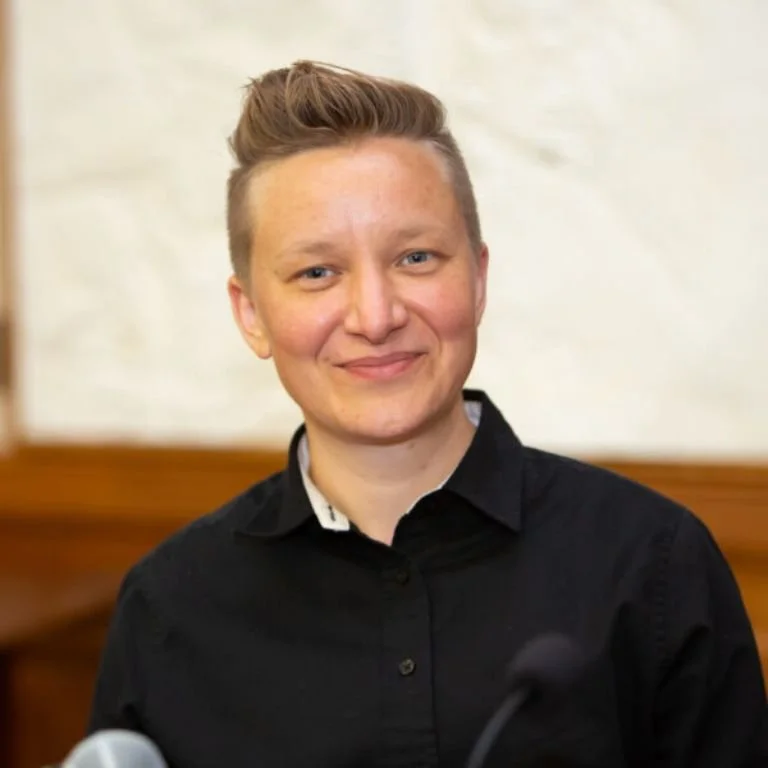
Author and speaker Hanna Reichel
RECENT HAPPENINGS
BIG QUESTION DAY - ‘What is the Cross?’ Saturday August 29 in Newburyport and Boston
Each Summer The St. Paul Center for Theology and Prayer hosts an in-person day to tackle a ‘Big Question’. This year we asked ‘What is the Cross?’
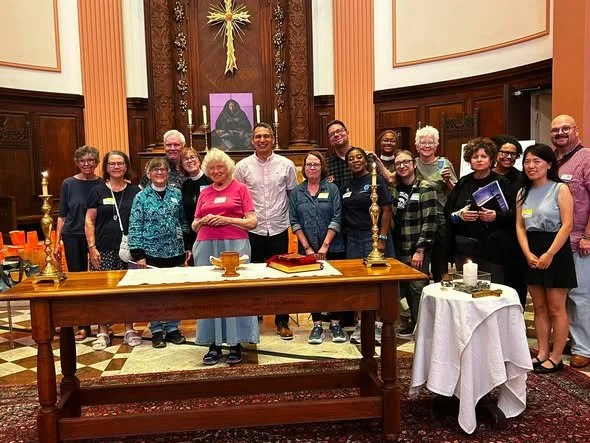
Attendees at the Cathedral
Jesus died on a cross. That much we can agree on. But beyond that, things get complicated and emotions get strong. “The Cross” is revered in devotions, lifted high in hymns, and sometimes wielded like a weapon. How we understand this central symbol of our tradition impacts how we live, how we love, and how we hope.
The Rev. Jarred Mercer hosted at St. Paul’s Newburyport, while the Very Rev. Amy McCreath was joined in hosting at the Cathedral by the Rev. Matthew Potts. Around 50 people joined across both venues. We’ll bring some reflections and insights from the day in our next newsletter. You can find the booklet which was given to attendees, and which all are welcome to keep and use to further ponder this ‘big question’, here.
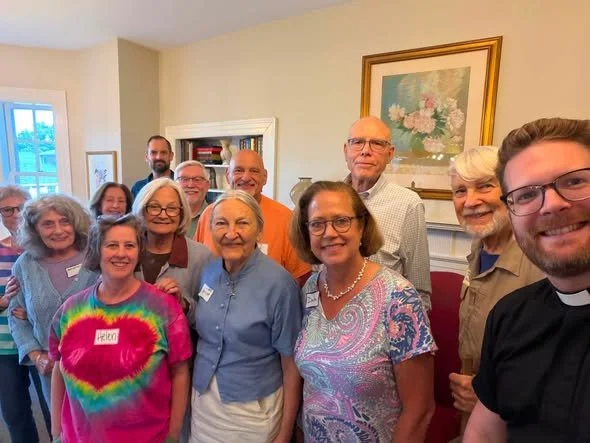
Attendees at St. Paul’s Newburyport
CLOSING WITH … A WELCOME AND A POEM
We’re delighted to welcome Canon Edwin Daniel Johnson to the TSPC team! The Rev. Johnson is the new Canon for Discipleship and Leadership Development for the Diocese. We look forward to charting the future for TSPC with him. He has composed a poem to close this Fall’s newsletter.
Joy In The Small
In our world that pushes for bigger and bigger.
Where goals are to be sought with legendary rigor.
As many for supremacy struggle, wrestle and even brawl.
There’s a different rhythm for those who find joy in the small.
As many are coming to grips with the need to rise above.
To recenter people, to once again find love.
There’s a path to where ones heart can stand ten feet tall.
And it includes the practice of finding joy in the small.
As our world moans with hunger for the presence of God.
As the needs of our communities grow more deep and more broad.
We who as disciples of Jesus faithfully answer the call.
Will find sustenance and refreshment though finding joy in the small.
Edwin Daniel Johnson
Please share your thoughts - or your questions! - with us. Our email inbox is always open! tspc@diomass.org